Roll-off dumpster rental with one exact delivered price
Renting a dumpster should take one message instead of five phone calls. Tell us your ZIP, what you're throwing out and when you need the box. We check the vetted local haulers that serve your address, and a real person texts or emails you one all-in delivered price: delivery, pickup, rental days and disposal up to the weight allowance, in a single number. Nothing is booked until you say yes, and nothing is charged to get the price.
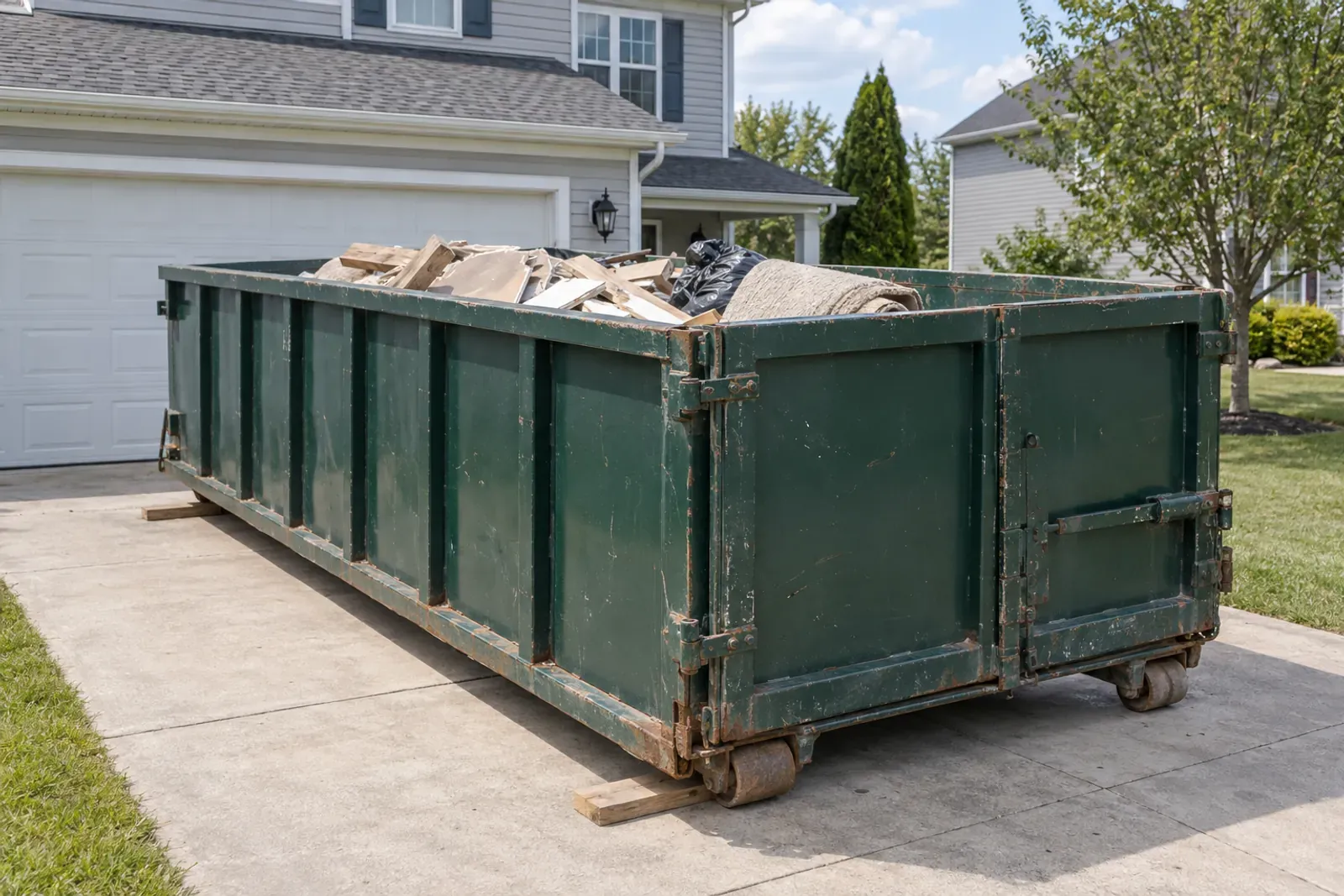
What a roll-off dumpster rental includes
A roll-off is the open-top steel box a truck slides off its bed onto your driveway or job site. Every quote we send covers the same four things:
- Delivery to the spot you choose
- Pickup when you tell us you're done, or when the rental period ends
- The rental period you pick: 3, 7, 14 or 30 days (7 is the most common)
- Disposal up to a stated weight allowance
Anything that could add to the total is written in the quote before you book: the per-ton rate over the allowance (typically $50 to $125, set by local landfill rates), the daily rate for extra days (often $10 to $20), per-item fees for things like mattresses, and whether your city needs a street permit. If a charge isn't in the quote, you shouldn't see it on the invoice. The full breakdown is on our dumpster rental prices page.
How it works
- Tell us the job. ZIP code, size (or your project, and we suggest one), what's going in, your delivery date and how long you need it.
- Get one exact price. A person on our team checks which haulers serve your address, who has your size on your date, and what disposal costs for your debris. Then you get one number by text or email.
- Say yes, fill it, we haul it. Delivery is usually 1 to 3 business days out, or on the date you pick. When you're done, tell us and it's gone.
Changes, extra days, early pickups and swaps all go through us, and you get one invoice per job with the address on it.
Roll-off dumpster sizes: 10 to 40 yards
A "yard" is a cubic yard, about a third of a standard pickup-truck bed. These are the five sizes our haulers carry, with typical figures for a 7-day rental. Exact dimensions and weight allowances vary a little by hauler, and your quote states them.
| Size | Outside dimensions (L x W x H) | Holds | Weight included | Typical 7-day price |
|---|---|---|---|---|
| 10-yard | 12 x 8 x 3.5 ft | about 3 pickup loads | 1 to 2 tons | $325 to $550 |
| 15-yard | 16 x 8 x 4 ft | about 4 to 5 pickup loads | 1 to 2 tons | $350 to $600 |
| 20-yard | 22 x 8 x 4 ft | about 6 pickup loads | 1 to 2 tons | $375 to $650 |
| 30-yard | 22 x 8 x 6 ft | about 9 pickup loads | 3 to 4 tons | $450 to $800 |
| 40-yard | 22 x 8 x 8 ft | about 12 pickup loads | 3 to 4 tons | $525 to $950 |
The 20-yard is the one we book most. It has the same 4-foot walls as a 15, so you can still toss things over the side, and it swallows most whole-house cleanouts and single-layer roof tear-offs. Heavy loads, long rentals and high-cost metro areas can push a total above the ranges in the table. All five boxes are drawn to the same scale in the dumpster size guide.
What size dumpster do you need?
Pick by the project, not by the price. One size too small means paying for a second haul, which costs more than going one size up. Our usual starting points:
- One room, attic or small garage: a 10-yard
- Bathroom remodel (tile, tub surround, vanity, toilet, drywall): a 10-yard
- Kitchen remodel (cabinets, counters, flooring, drywall): a 15-yard
- Packed two-car garage or basement: a 15-yard
- Whole-house or estate cleanout with furniture: a 20 or 30-yard
- Roof tear-off on an average-size home: a 20-yard, sized by weight
- Yard cleanup: a 15 or 20-yard; an overgrown lot or several trees can call for a 30
- Addition or gut renovation: a 30-yard
- New construction or light demolition: a 40-yard
Heavy debris is the exception. Concrete, dirt, brick, rock and tile go in a 10-yard only, filled to a line the hauler marks (often about halfway). Solid concrete weighs about 2 tons per cubic yard, so a bigger box full of it would be too heavy for the truck to lift or to drive legally. See concrete and dirt dumpsters for how heavy loads are priced.
Still not sure? Tell us the project in the quote form. We suggest a size and double-check it against what you're loading before we send a price.
Weight matters more than most people expect
Every rental includes a weight allowance, typically 1 to 2 tons for 10 to 20-yard boxes and 3 to 4 tons for 30 and 40-yards. Household junk and yard waste are light; you'll run out of room before you run out of weight. Shingles and drywall are the opposite. A single layer of asphalt shingles on an average house weighs roughly 2 to 4 tons, and a 20-yard filled with drywall alone would come in near 4.7 tons.
So tell us about anything dense when you request a price: shingle layers, tile, plaster, stone countertops, wet debris. We match the allowance to the job. Our dumpster weight limits guide lists what common materials weigh, using EPA figures.
What can't go in a dumpster
Most junk, furniture, construction debris, roofing and yard waste is fine. A short list is off-limits almost everywhere:
- Liquid paint, stains, solvents and household chemicals
- Tires, car batteries and lithium-ion batteries
- Refrigerators, freezers, AC units and anything else holding refrigerant
- Propane tanks, fuel and other pressurized cylinders
- Asbestos and medical waste
- TVs, monitors and other electronics, in many states
Mattresses, box springs and appliances without refrigerant are usually accepted with a per-item fee. Rules change from one county to the next, so we check what applies at your address when we quote. The prohibited items list covers what to do with each one instead.
Where the dumpster goes
Most roll-offs sit on a driveway. You need a flat spot about the length of the box (12 to 22 feet) and 8 to 11 feet wide, plus roughly 60 feet in a straight line for the truck to back in, and no low wires or branches overhead. Many haulers set the box on boards to spread the weight; ask for them in the quote form. Avoid fresh asphalt, decorative pavers and soft ground if you can.
On your own driveway you usually don't need a permit. If the box has to sit on the street, sidewalk or a public alley, most cities require one, and some HOAs have their own rules. We tell you what applies at your address before you book.
We deliver dumpsters nationwide with our local haulers in the largest US metro areas, and we can often help outside them. Enter your ZIP and we'll tell you whether we can deliver to your address.
Why people book through us instead of calling around
- Our haulers are vetted, insured and bonded. Before a hauler takes jobs from us, they show a current certificate of insurance and a bond. No certificate, no jobs. Read how we choose your hauler.
- One number, in writing. Delivery, pickup, rental days and weight allowance are in the price, and every possible extra is listed next to it.
- One person to text. Extra day, early pickup, a second box, a question about a dried paint can: you message us, we sort it with the hauler.
- Straight sizing advice. If a cheaper size will do, or a bigger one saves you a second haul, we say so before you commit.
Frequently Asked Questions
How much does a dumpster rental cost?
Typical 7-day prices run from about $325 for a 10-yard to about $950 for a 40-yard. High-cost areas, heavy loads and long rentals can go above that range. Your ZIP, the size, the debris type and the rental length set the exact number, and you see it before you commit to anything.
How fast can you deliver a dumpster?
Usually 1 to 3 business days after you book, or on the date you choose. Next-day delivery is sometimes possible, depending on the local hauler's schedule and the season. Put your preferred date in the quote form and we'll tell you what's realistic.
How long can I keep the dumpster?
Pick 3, 7, 14 or 30 days when you request a price; 7 days is the most common. If the job runs long, extra days are billed daily at the rate in your quote, usually around $10 to $20 per day. Filled it early? Tell us and we schedule an early pickup or a swap for an empty box.
Do I need to be home for delivery?
No. If the spot is clear and you've told us where the box should go, the driver places it and leaves. Mark the spot with a cone or a chair if you won't be there, and keep cars and bins out of the way to avoid a $75 trip fee for a failed delivery.
Can I cancel or change my booking?
Changes and cancellations are free, with a full refund, until the truck leaves for your delivery. Once the truck is on its way, cancelling costs $50. Moving the delivery date is free, however late you tell us. The rental price covers the whole period and weight allowance, so unused days or weight aren't refunded.
Get your exact delivered price
Tell us your ZIP and what's going in the box. A real person checks local haulers and texts or emails you one all-in number for your address, usually within 1-2 business hours. No payment to get a price, and nothing is booked until you say yes.